Not sure which tests to take? Share your prescription with us and our team will call you to book tests for you.
Request a Call Back
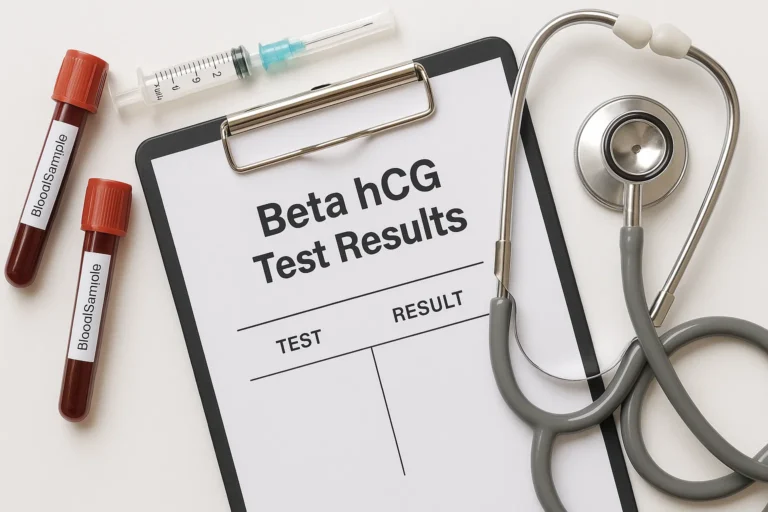
Beta hCG Blood Test – How It Works, When to Take It, and What Your Numbers Mean
October 31,2025
Have you ever thought about how a simple blood test can tell you so much about your health, your pregnancy, or even your ability to get pregnant? The beta hCG test is like an early warning from your body that something big might be about to happen.
Let’s simplify it: what it measures, why it matters, and how to make sense of those strange numbers your doctor talks about.
What is a Beta hCG Test, Really?
The beta hCG test, which is also called the hCG beta test or beta hCG pregnancy test, looks for levels of the hormone human chorionic gonadotropin (hCG) in your blood.
You can think of hCG as your body’s “pregnancy messenger.” The placenta starts to make this hormone as soon as an embryo implants into the uterus. It’s like the first sign of a growing pregnancy.
Doctors usually measure it in two ways:
Qualitative hCG Test: This test tells you if you’re pregnant or not.
The Quantitative Beta hCG Test: It tells you how much hCG is in your blood, which gives you more information about how a pregnancy or treatment is going.
When should you get an hCG beta test?
Timing is key. If you take it too soon, your hCG levels might still be too low to see, like trying to listen to a radio station before the signal gets to your area.
For natural conception: You can take the test 10 to 14 days after ovulation or after you miss your period.
For IVF or other fertility treatments: The test is usually done 13 to 14 days after egg retrieval or embryo transfer.
For medical reasons: Doctors may use the hCG test to keep an eye on hormone levels even when a woman isn’t pregnant, especially when looking into certain cancers or fertility problems.
What Do Beta hCG Levels Mean?
This is the fun (and sometimes hard to understand) part: figuring out what your results mean.
In the first few weeks of pregnancy, the hCG levels change quickly, usually doubling every 48 to 72 hours. That’s why your doctor might ask you to take a lot of tests over a few days to see how things are changing instead of just one number.
Pregnancy Stage
Typical Beta hCG Range (mIU/mL)
3 weeks
5 – 50
4 weeks
5 – 426
5 weeks
18 – 7,340
Non-pregnant
< 5
If your numbers are lower than expected, it could mean an early miscarriage or an ectopic pregnancy.
More than usual could mean twins or, in rare cases, some health problems like trophoblastic disease.
Keep in mind that context is important; your doctor will always look at results in light of symptoms and ultrasounds.
The Beta hCG Test: More Than Just for Pregnancy
You might be surprised to learn that this test isn’t just for confirming pregnancy. The beta hCG blood test also helps with:
Keeping an eye on the health of a woman in early pregnancy can help find problems like ectopic pregnancy.
Keeping an eye on fertility treatments, especially after IVF, to see if the implantation worked.
Finding some cancers: some tumors make hCG, so this test can help with diagnosis and monitoring.
After a miscarriage, monitoring hormone levels to make sure they go back to normal.
How to Do the Beta hCG Test
If you’re thinking of something hard, relax. The hCG test is as easy as getting your blood drawn for any other reason.
A nurse or technician takes a small amount of blood from your arm.
The lab will look at the sample.
You can usually get qualitative results in a few hours and quantitative results in one to two days.
No fasting or long preparation. If you’re taking any fertility drugs, just let your doctor know because some of them can change hCG levels a little bit.
What Happens Next After the Test?
What you do next will depend on how well you did.
Normal Levels: You don’t need to do anything else unless your doctor tells you to.
Levels Going Up or Down: More tests, like ultrasounds or repeated beta hCG tests, can help figure out what’s going on.
After IVF, keep an eye on: Your doctor might test you again after 48 hours, even if your first test was low. This is because embryos sometimes take longer to “announce” themselves.
Is the Beta hCG Test Trustworthy?
Of course. The beta hCG pregnancy test is one of the best ways to tell if you’re pregnant early on. But it can’t promise that a pregnancy will go normally; only an ultrasound can do that.
Advantages of Getting a Beta hCG Test
Finds out about pregnancy sooner than urine tests.
Keeps track of how the pregnancy is going with data that can be measured.
Confirms implantation, which helps with fertility treatments.
Helps doctors figure out what’s wrong with people who aren’t pregnant.
It’s a small test that gives you a lot of information.
Last Thoughts
The beta hCG test can help you feel better when you’re anxious and waiting for good news or going through fertility treatment. Knowing what your results mean gives you the power to talk to your doctor in an informed way, which is half the battle.
Frequently Asked Questions (FAQs)
1. What is the purpose of the beta hCG test?
It is primarily utilized to verify pregnancy, track its development, identify ectopic pregnancies, and aid in the diagnosis of specific cancers.
2. After IVF or embryo transfer, when can I take the hCG beta test?
For accurate results, it usually takes 12 to 14 days after the embryo transfer.
3. Is it possible for men to take a beta hCG test?
Yes. In men, it can be used to find tumors that make hCG, like some testicular cancers.
4. What is the difference between the hCG test and the beta hCG test?
The beta version tests for a specific subunit of the hormone, which gives more accurate results.
5. Do I need to not eat before the test?
You don’t have to fast unless your doctor says you should.
6. What if I’m pregnant but my hCG levels are low?
You might just be very early in your pregnancy. Your doctor might repeat the test after 48 hours to see if the levels go up as they should.
7. Does a high beta hCG level mean twins?
Yes, higher levels can sometimes mean more than one pregnancy, but only an ultrasound can tell for sure.
8. Are home pregnancy tests as good?
They work well for finding hCG in urine, but blood tests are better, especially in the first few weeks of pregnancy.
9. When will the results be ready?
For quantitative results, usually within 24 to 48 hours.
10. Does the beta hCG test hurt?
Not really, just a small prick for the blood sample and maybe some mild pain.




Leave a Reply