Introduction
Feeling tired all the time? Experiencing unexplained weight changes, hair fall, mood swings, or irregular periods? While these symptoms can occur for many reasons, they may sometimes be associated with a thyroid disorder.
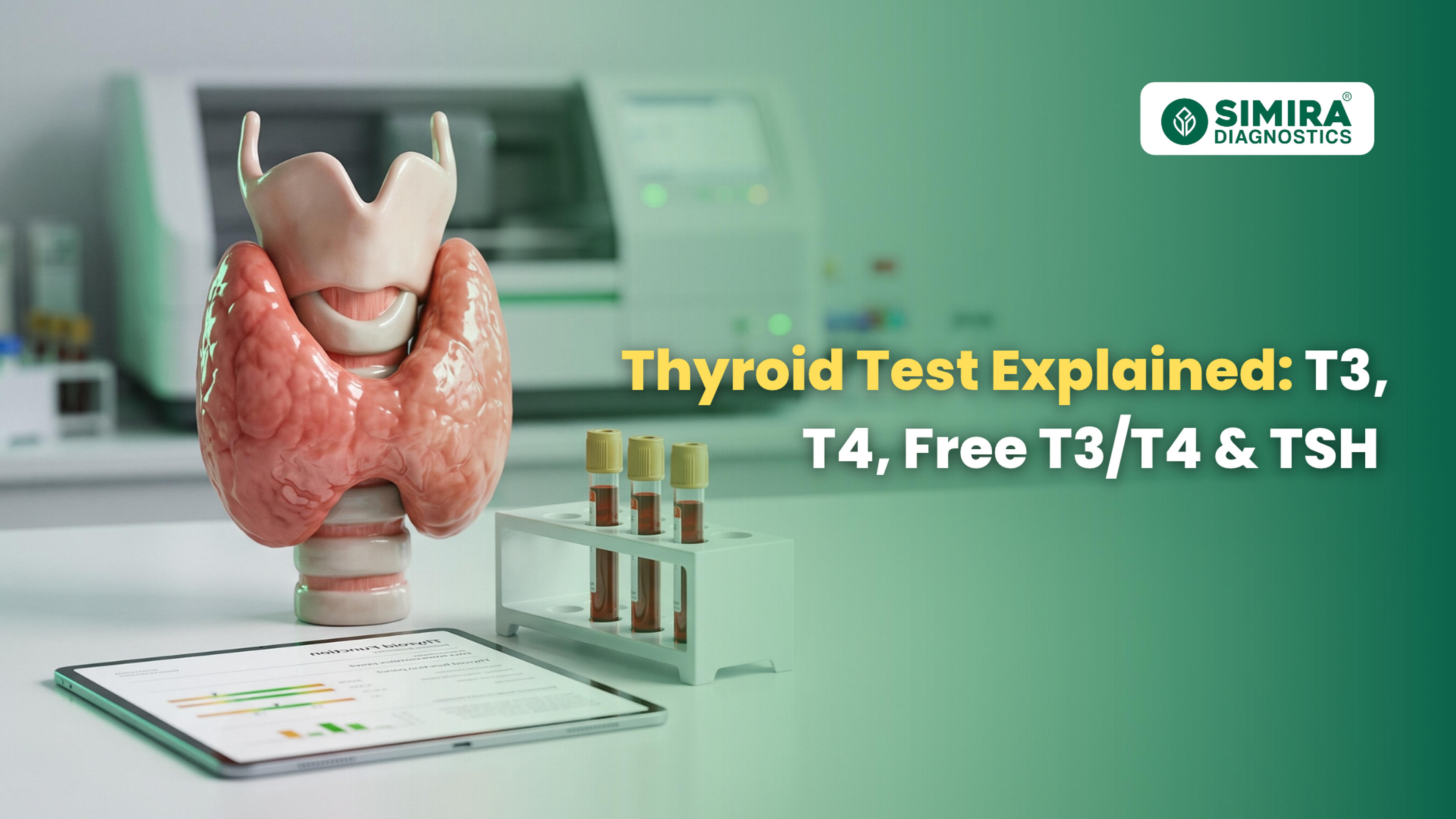
The thyroid is a small, butterfly-shaped gland located at the front of your neck. It produces hormones that help regulate metabolism, body temperature, heart rate, energy levels, and several other important body functions.
When the thyroid produces too much or too little hormone, it can affect your overall health. Thyroid function tests, including TSH, T3, T4, Free T3, and Free T4, help doctors evaluate how well your thyroid is functioning.
But what is the difference between these tests? Is TSH enough, or do you also need T3 and T4 testing?
In this blog, we explain the different thyroid blood tests, common symptoms of thyroid imbalance, how to prepare for testing, and how doctors interpret thyroid test results.
What Is the Thyroid Gland and Why Is It Important?
The thyroid gland produces two primary hormones:
- Thyroxine (T4): The main hormone released by the thyroid. Much of it is converted into the more active hormone T3 in other tissues.
- Triiodothyronine (T3): The more biologically active thyroid hormone that helps regulate metabolism and other body functions.
The pituitary gland, located at the base of the brain, produces thyroid-stimulating hormone (TSH). TSH signals the thyroid gland to produce thyroid hormones.
When thyroid hormone levels change, the pituitary gland adjusts TSH production to help maintain balance.
This relationship is important because TSH is often the first blood test used to evaluate thyroid function, while Free T4 and sometimes T3 provide additional information.
1. TSH Test: The First Step in Thyroid Function Testing
The TSH blood test measures thyroid-stimulating hormone in your blood. It is commonly used as an initial test to assess whether the thyroid may be underactive or overactive.
What does the TSH test indicate?
TSH levels can provide important clues about thyroid function.
- High TSH: Often suggests an underactive thyroid, known as hypothyroidism, particularly when Free T4 is low.
- Low TSH: Often suggests an overactive thyroid, known as hyperthyroidism, particularly when Free T4 or T3 is elevated.
- TSH within the reference range: Often indicates normal thyroid function, although interpretation depends on symptoms, medical history, pregnancy status, medications, and other test results.
These patterns are not universal. For example, certain pituitary disorders can produce unusual combinations of TSH and thyroid hormone results.
When might a doctor recommend a TSH test?
A doctor may recommend TSH testing if you experience:
- Persistent fatigue or low energy
- Unexplained weight gain or weight loss
- Increased sensitivity to cold or heat
- Hair thinning or hair fall
- Changes in heart rate
- Menstrual irregularities
- Difficulty managing cholesterol levels
- Symptoms suggesting a thyroid disorder
- A need to monitor existing thyroid treatment
TSH testing may also be considered in selected individuals without symptoms, depending on their medical history and risk factors.
2. T3 Test: Measuring Triiodothyronine
The T3 blood test measures triiodothyronine, one of the main hormones produced by the thyroid system.
T3 plays an important role in regulating metabolism, body temperature, heart rate, and energy use.
T3 testing may be especially helpful when a doctor suspects hyperthyroidism, because T3 can be elevated even when Free T4 is within the reference range.
What is the difference between Total T3 and Free T3?
There are two main forms of T3 testing.
Total T3: Measures the combined amount of T3 circulating in the blood, including hormone bound to proteins and the small amount that is unbound.
Free T3 (FT3): Measures the unbound portion of T3, which is available to enter tissues and exert its effects.
Thyroid hormones circulate largely attached to proteins. Changes in these proteins can affect total hormone measurements, even when free hormone levels remain relatively stable.
When is a T3 test recommended?
A doctor may request T3 or Free T3 testing when:
- Hyperthyroidism is suspected
- TSH is low and further evaluation is needed
- Symptoms suggest an overactive thyroid despite a normal Free T4 result
- A known thyroid disorder requires additional assessment
T3 testing is not always necessary for routine thyroid screening. The choice depends on your symptoms and initial test results.
3. T4 Test: Measuring Thyroxine
T4, or thyroxine, is the primary hormone produced by the thyroid gland. It acts as a circulating source of hormone that can be converted into T3 in different tissues.
The T4 blood test helps assess thyroid hormone levels and is frequently interpreted alongside TSH.
What is Total T4?
Total T4 measures both protein-bound and unbound thyroxine in the blood.
Because most T4 is attached to proteins, changes in protein levels can affect Total T4 results. Pregnancy, certain medications, and other conditions may alter these binding proteins.
As a result, Total T4 levels may change even when the thyroid gland itself is functioning normally.
When might a Total T4 test be useful?
A doctor may request Total T4 as part of a thyroid evaluation or when specific clinical circumstances make total hormone measurements useful.
However, Free T4 is commonly used when additional information about circulating thyroid hormone levels is needed.
4. Free T4 Test: Understanding the Active, Unbound Hormone
The Free T4 (FT4) test measures the unbound portion of thyroxine in the blood.
It is commonly used with TSH to investigate suspected hypothyroidism or hyperthyroidism and to clarify abnormal TSH results.
What can Free T4 results indicate?
- High TSH with low Free T4: Often consistent with primary hypothyroidism.
- Low TSH with high Free T4: Often consistent with hyperthyroidism.
- High TSH with normal Free T4: May indicate subclinical hypothyroidism, depending on the clinical context.
- Low TSH with normal Free T4: May indicate subclinical hyperthyroidism or require further investigation, including T3 testing in some cases.
These patterns are general guides, not standalone diagnoses. Other medical conditions, medicines, pregnancy, and laboratory interference can affect the interpretation.
Free T4 vs Total T4: Which is better?
Neither test is universally better in every situation. Free T4 is commonly preferred when evaluating thyroid function alongside TSH because it is less directly affected by changes in thyroid hormone-binding proteins.
Your doctor will select the appropriate test based on your circumstances.
5. TSH vs T3 vs T4 vs Free T3 vs Free T4: What's the Difference?
Understanding the purpose of each thyroid test can help you make sense of your laboratory report.
| Test | What it measures | Common use |
| TSH | Thyroid-stimulating hormone from the pituitary gland | Initial assessment of thyroid function |
| Total T3 | Bound and unbound triiodothyronine | Further evaluation, particularly when hyperthyroidism is suspected |
| Free T3 (FT3) | Unbound triiodothyronine | Selected cases of suspected hyperthyroidism |
| Total T4 | Bound and unbound thyroxine | Thyroid evaluation in selected clinical situations |
| Free T4 (FT4) | Unbound thyroxine | Evaluating abnormal TSH results and suspected thyroid disorders |
Key takeaway: Many people begin with TSH testing, often alongside Free T4 when clinically appropriate. T3 testing may be added when hyperthyroidism is suspected or more information is required.
You do not necessarily need all five tests. Your doctor can recommend the most suitable combination based on your symptoms, medical history, and initial results.
6. Common Symptoms of Thyroid Imbalance
Thyroid disorders can affect several body systems. Symptoms may develop gradually, and some people have very few noticeable symptoms.
Symptoms of hypothyroidism (underactive thyroid)
Hypothyroidism occurs when the body does not have enough thyroid hormone activity.
Possible symptoms include:
- Persistent tiredness or fatigue
- Unexplained weight gain
- Increased sensitivity to cold
- Constipation
- Dry skin and hair thinning
- Slower heart rate
- Difficulty concentrating
- Heavy or irregular menstrual periods
Symptoms of hyperthyroidism (overactive thyroid)
Hyperthyroidism occurs when the body has excessive thyroid hormone activity.
Possible symptoms include:
- Unexplained weight loss
- Rapid or irregular heartbeat
- Anxiety, nervousness, or irritability
- Increased sweating
- Heat intolerance
- Shaky hands
- Frequent bowel movements
- Difficulty sleeping
- Menstrual changes
These symptoms can overlap with many other health conditions. Thyroid blood tests and medical evaluation help determine whether the thyroid is involved.
7. What Is a Thyroid Profile Test?
A thyroid profile test is a group of blood tests used to evaluate thyroid function. The exact tests included can vary between laboratories and diagnostic packages.
A thyroid profile may include:
Some test packages may instead include TSH and Free T4, while others offer additional measurements.
Before booking a test, check which parameters are included rather than assuming every thyroid profile contains T3, T4, Free T3, and Free T4.
Is a thyroid profile enough to diagnose a thyroid disorder?
A thyroid profile can provide useful information, but no single combination of blood tests explains every thyroid condition.
Depending on the results, your doctor may recommend additional investigations, such as thyroid antibody tests or thyroid imaging.
For example, thyroid peroxidase antibodies (TPO antibodies) may help evaluate suspected autoimmune thyroid disease. Thyroid ultrasound may be recommended when there is a thyroid lump, enlargement, or another structural concern.
These investigations are different from routine thyroid hormone testing and are not necessary for everyone.
8. How to Prepare for a Thyroid Blood Test
Preparing correctly can help reduce avoidable problems with thyroid test interpretation.
Do you need to fast before a thyroid test?
Fasting is generally not required for routine TSH, T3, or T4 blood tests. However, follow the instructions provided by your doctor or diagnostic laboratory, particularly if other tests are being performed at the same time.
Inform your doctor about medications
Tell your healthcare provider if you take thyroid medication, hormonal medicines, supplements, or other prescription drugs.
Do not stop or change your medication without medical advice.
If you take levothyroxine, your doctor may advise you to have your blood sample collected at a consistent time relative to your dose, especially when monitoring treatment.
Be aware of biotin supplements
Biotin, a vitamin commonly found in hair, skin, and nail supplements, can interfere with some thyroid laboratory tests and produce misleading results.
Inform your doctor and laboratory if you take biotin. They can advise whether you need to pause it before testing and for how long, depending on the dose and the assay used. Do not stop prescribed supplements without appropriate advice.
Tell your doctor if you are pregnant
Pregnancy changes thyroid hormone requirements and affects how results are interpreted. Pregnancy-specific reference ranges and clinical guidance may be needed.
9. How to Understand Your Thyroid Test Report
Your thyroid report usually lists the measured result alongside a reference range.
Reference ranges can differ between laboratories because of the testing methods used. Therefore, always compare your result with the range printed on your own report.
What if my TSH is high?
A high TSH may indicate that the thyroid is not producing enough hormone. Your doctor may check Free T4 and assess your symptoms to determine whether hypothyroidism is present.
What if my TSH is low?
A low TSH may suggest excessive thyroid hormone activity. Your doctor may review Free T4 and T3 results to investigate possible hyperthyroidism or other causes.
What if my TSH is normal but I still have symptoms?
A TSH result within the reference range often indicates normal thyroid function, but persistent symptoms still deserve attention.
Your doctor may consider other causes, medication effects, pregnancy, or whether additional thyroid evaluation is appropriate. Symptoms such as fatigue and hair fall are not specific to thyroid disease.
Can I diagnose a thyroid disorder from the report myself?
No. Thyroid results should be interpreted alongside symptoms, medical history, medication use, and other clinical findings.
If your report shows an abnormal result, discuss it with a qualified healthcare professional before starting treatment or changing an existing prescription.
10. Why Regular Thyroid Monitoring Matters
For people diagnosed with a thyroid disorder, follow-up testing helps doctors assess hormone levels and determine whether treatment needs adjustment.
Monitoring may be recommended for:
- People taking thyroid hormone replacement medication
- People receiving treatment for hyperthyroidism
- Selected individuals with borderline or changing thyroid results
- Pregnant people with known thyroid disease
- People whose symptoms or medical circumstances have changed
The frequency of testing depends on the condition, medication, pregnancy status, and previous results. Testing too frequently without a clinical reason may not be helpful, so follow the monitoring schedule recommended by your doctor.
Conclusion: Understand Your Thyroid Health with the Right Tests
The thyroid plays an important role in regulating metabolism, energy, heart rate, and several other body functions. When thyroid hormone levels become unbalanced, symptoms may include fatigue, weight changes, hair fall, temperature sensitivity, and menstrual irregularities.
Understanding the difference between TSH, T3, T4, Free T3, and Free T4 can help you better understand your thyroid report. TSH is often the starting point for thyroid evaluation, while Free T4 and T3 provide additional information when needed.
At Simira Diagnostics, you can enquire about available thyroid function tests and the parameters included in each test package. Discuss your symptoms and test requirements with your healthcare professional to determine which investigations are appropriate for you.
Take an informed step towards better thyroid health. Understand your results, follow medical advice, and seek timely evaluation when symptoms persist.
Medical Disclaimer
Disclaimer: This article is intended for general educational and awareness purposes only. It is not a substitute for medical diagnosis, treatment or professional medical advice. Health screening recommendations vary according to age, sex, symptoms, medical history, medications, family history and individual risk factors. Please consult a qualified healthcare professional before deciding which tests or screenings are appropriate. Do not start, stop or change medication based solely on information in this article.