Testicular cancer is one of the most important reproductive health concerns for young men. Although it is relatively uncommon compared with other cancers, it is among the most common cancers affecting men between approximately 15 and 35 years of age.
One challenge is that early testicular cancer may not cause pain or noticeable symptoms beyond a small lump, swelling, or change in the testicle. This is why understanding testicular health and recognising unusual changes are important.
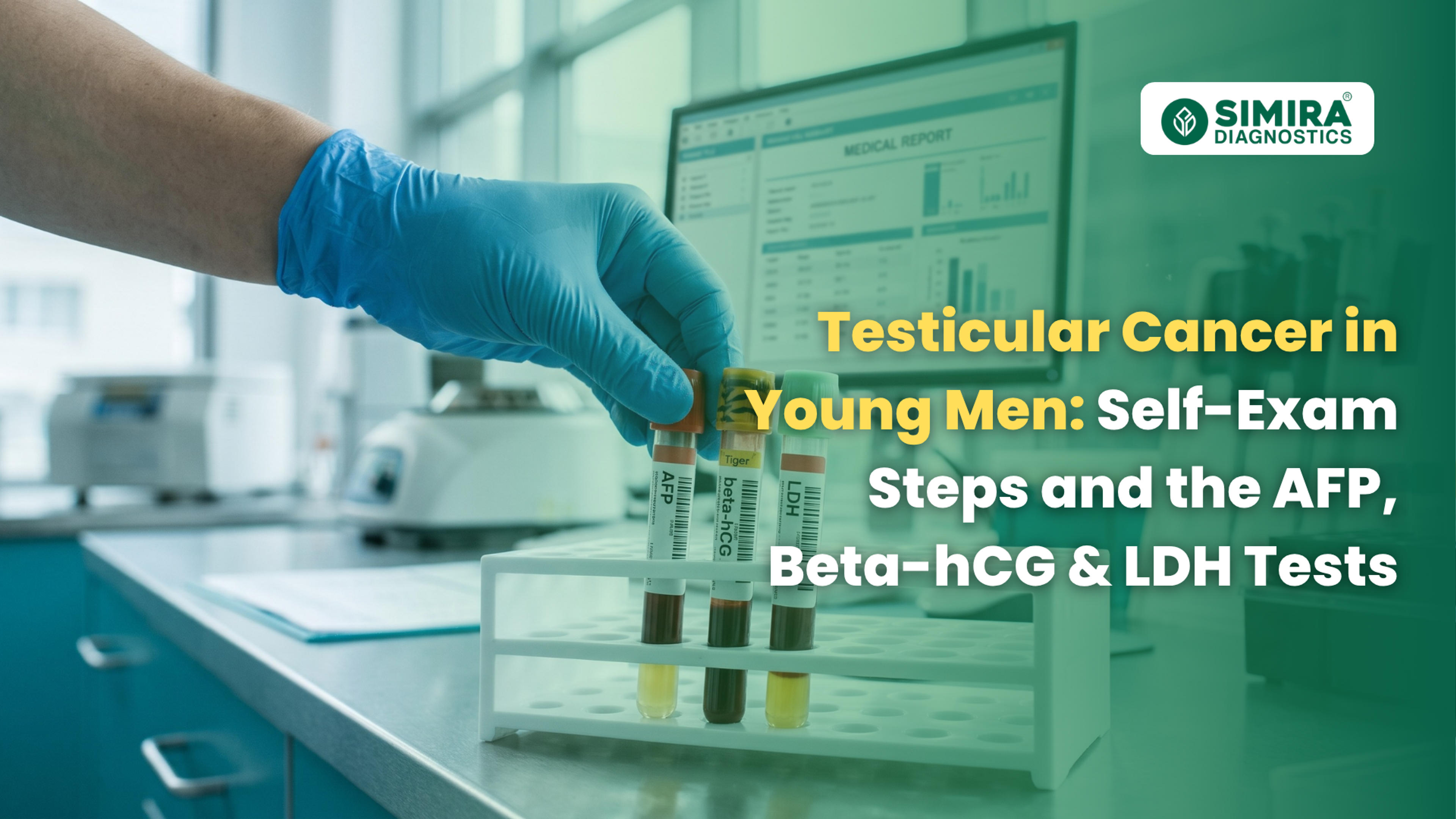
A testicular self-examination can help men become familiar with their normal anatomy and notice changes that need medical attention. If a doctor suspects testicular cancer, investigations may include a scrotal ultrasound and blood tests for three important tumour markers: AFP (Alpha-fetoprotein), Beta-hCG (Beta-human chorionic gonadotropin), and LDH (Lactate dehydrogenase).
In this guide, we explain the warning signs of testicular cancer, how to perform a self-examination, what these blood tests measure, and when to consult a healthcare professional.
What Is Testicular Cancer?
Testicular cancer develops when cells in one or both testicles begin growing abnormally and uncontrollably.
The testicles, also called testes, are part of the male reproductive system. They are responsible for:
- Producing sperm.
- Producing testosterone.
- Supporting male reproductive development and sexual function.
Most testicular cancers develop from germ cells, which are responsible for producing sperm. These cancers are broadly classified into two main types:
1. Seminoma
Seminomas are germ cell tumours that generally grow more slowly than many non-seminoma tumours. They can occur in younger and middle-aged adults.
2. Non-Seminoma
Non-seminomas include several types of germ cell tumours, such as embryonal carcinoma, yolk sac tumour, choriocarcinoma, and teratoma.
Some testicular cancers contain a mixture of different tumour types.
The distinction matters because different tumour types can produce different blood tumour marker patterns and may require different treatment approaches.
Why Is Testicular Cancer Awareness Important in Young Men?
Testicular cancer often affects younger men, a group that may not regularly discuss reproductive health or undergo medical examinations.
Awareness is important because:
- Early symptoms may be painless.
- A small lump may be the first noticeable change.
- Young men may delay medical consultation due to embarrassment or lack of awareness.
- Early medical evaluation can help establish the diagnosis and guide treatment.
- Treatment planning may include discussions about future fertility.
Testicular cancer is often highly treatable, particularly when identified at an early stage. Any unusual testicular change should therefore be evaluated rather than ignored.
Common Signs and Symptoms of Testicular Cancer
Testicular cancer does not always cause pain. Some men discover an abnormality accidentally, while others notice changes during bathing or dressing.
Common symptoms include:
1. A Lump or Swelling in the Testicle
A painless lump or swelling in one testicle is one of the most common warning signs.
Not every lump is cancerous, but any new testicular lump should be assessed by a healthcare professional.
2. A Change in Testicular Size or Shape
One testicle may become larger, feel different, or develop an unusual shape.
A noticeable change that persists should not be ignored.
3. A Feeling of Heaviness in the Scrotum
Some men experience heaviness or a dragging sensation in the scrotum.
4. Pain or Discomfort
Testicular cancer can sometimes cause:
- Dull pain in the testicle.
- Discomfort in the scrotum.
- Pain in the lower abdomen or groin.
- Occasional back pain.
Pain is not always present, and its absence does not rule out a problem.
5. Breast Tenderness or Enlargement
Some testicular tumours can produce hormones that may cause breast tenderness or enlargement, known as gynaecomastia.
6. Other Symptoms
In more advanced cases, symptoms may include persistent back pain, unexplained weight loss, or other symptoms depending on whether the cancer has spread.
Important: These symptoms can also occur with non-cancerous conditions, such as cysts, infections, or inflammation. Medical assessment is needed to identify the cause.
Sudden, severe testicular pain requires immediate emergency medical attention because conditions such as testicular torsion can threaten blood supply to the testicle.
Testicular self-examination is a way to become familiar with the normal size, shape, and feel of your testicles.
There is no evidence that routine self-examination reduces deaths from testicular cancer, and it is not an established population screening test. However, knowing what is normal for your body can help you recognise unusual changes and seek medical advice.
Step-by-Step Self-Examination Guide
<AsyncImage query="medical educational illustration male testicular self examination hands checking testicles anatomy neutral clinical infographic" aspectRatio="16:9" width="100%" maxHeight={220} fit="contain"/>
Step 1: Choose a comfortable time
A warm shower or bath is a convenient time because the scrotal skin is relaxed, making it easier to feel the testicles.
Step 2: Examine one testicle at a time
Stand comfortably and gently hold one testicle between your thumb and fingers.
Step 3: Gently roll the testicle
Roll the testicle gently between your thumb and fingers. Avoid squeezing or applying excessive pressure.
Step 4: Notice its size and texture
Become familiar with its usual size, shape, and consistency. A healthy testicle generally feels smooth and firm, but not hard.
Step 5: Identify the epididymis
At the back and upper part of each testicle is a soft, tube-like structure called the epididymis. It stores and transports sperm.
It is normal to feel this structure. Do not mistake it for a new lump on the testicle itself.
Step 6: Repeat on the other side
Examine the other testicle in the same way and become familiar with any natural differences between the two.
What Changes Should You Look For?
Pay attention to:
- A new lump or hard area.
- An increase in size.
- A change in shape or consistency.
- Persistent swelling.
- A feeling of heaviness.
- Unusual or persistent discomfort.
If you notice any new or unexplained change, arrange a medical evaluation. Do not attempt to diagnose yourself based on touch alone.
Which Tests Help Detect Testicular Cancer?
If a doctor suspects testicular cancer, several investigations may be recommended.
The evaluation commonly includes:
- Physical examination.
- Scrotal ultrasound.
- Blood tumour marker tests.
- Additional imaging when indicated.
- Histopathological examination following surgery when necessary.
Three important blood tumour markers used in the evaluation of testicular germ cell tumours are AFP, Beta-hCG, and LDH.
Understanding the AFP, Beta-hCG and LDH Blood Tests
These blood tests measure substances that may be elevated in certain types of testicular cancer.
They help doctors support diagnosis, assess disease stage, plan treatment, and monitor response to treatment.
1. AFP Test – Alpha-fetoprotein
AFP stands for Alpha-fetoprotein. It is a protein normally produced in significant amounts by the developing foetus.
In adults, elevated AFP levels may occur in certain conditions, including some non-seminomatous germ cell tumours.
Why is the AFP test important?
- Helps identify certain non-seminomatous testicular tumours.
- Supports tumour classification alongside other investigations.
- Helps assess disease stage.
- Can be monitored during and after treatment.
Important clinical point: Pure seminomas do not produce AFP. If AFP is elevated in a patient whose tumour appears to be seminoma, doctors investigate the possibility of a non-seminomatous component or another cause of the elevated result.
AFP can also be elevated in certain liver conditions, so an increased result does not automatically mean testicular cancer.
2. Beta-hCG Test – Beta-human Chorionic Gonadotropin
Beta-hCG is a hormone best known for its role in pregnancy testing. However, certain testicular germ cell tumours can also produce it.
Why is the Beta-hCG test important?
- Helps identify certain germ cell tumours.
- May be elevated in seminomas and non-seminomas.
- Supports diagnosis and staging.
- Helps monitor treatment response and possible recurrence.
Not every testicular tumour produces Beta-hCG. Therefore, normal levels do not rule out testicular cancer.
3. LDH Test – Lactate Dehydrogenase
LDH is an enzyme found in many tissues throughout the body, including muscles, the liver, kidneys, and blood cells.
Elevated LDH may be seen in testicular cancer, but it is not specific to cancer.
Why is the LDH test important?
- May provide additional information about tumour burden.
- Helps doctors with staging and risk assessment.
- Can be monitored during treatment and follow-up.
- Complements AFP and Beta-hCG results.
LDH can also increase due to several non-cancerous conditions, including tissue injury, muscle damage, liver disease, and breakdown of blood cells.
An elevated LDH result alone cannot diagnose testicular cancer.
AFP vs Beta-hCG vs LDH: What Is the Difference?
| Test | What it measures | Role in testicular cancer evaluation |
| AFP | Alpha-fetoprotein protein | May be elevated in non-seminomatous tumours |
| Beta-hCG | Human chorionic gonadotropin hormone | May be elevated in seminomas and non-seminomas |
| LDH | Lactate dehydrogenase enzyme | Provides additional information for staging and tumour burden |
Doctors generally interpret all three markers together with examination, ultrasound, and other findings.
Can Normal Tumour Marker Levels Rule Out Testicular Cancer?
No.
Some testicular cancers do not produce AFP, Beta-hCG, or LDH at levels above the laboratory reference range.
Therefore:
- Normal AFP does not exclude testicular cancer.
- Normal Beta-hCG does not exclude testicular cancer.
- Normal LDH does not exclude testicular cancer.
A suspicious testicular lump still requires medical evaluation even when tumour marker results are normal.
Why Is a Scrotal Ultrasound Important?
A scrotal ultrasound is an important imaging investigation when a testicular lump or abnormality is suspected.
It uses sound waves to create images of the testicles and surrounding structures.
It helps doctors:
- Identify whether a lump is inside or outside the testicle.
- Assess the size and location of an abnormality.
- Examine both testicles.
- Differentiate between solid masses and fluid-filled structures.
- Guide further medical evaluation.
Blood tumour markers and ultrasound provide different types of information. Neither should be interpreted in isolation.
What Happens If Tumour Marker Levels Are Elevated?
An elevated AFP, Beta-hCG, or LDH result does not automatically confirm testicular cancer.
The doctor will consider:
- The degree of elevation.
- The patient's symptoms and examination findings.
- Scrotal ultrasound results.
- Other possible medical causes.
- Additional imaging and clinical findings.
If testicular cancer is strongly suspected, a urologist may recommend an inguinal orchiectomy, which involves removing the affected testicle through an incision in the groin.
The removed tissue is examined under a microscope to establish the diagnosis and identify the tumour type.
A needle biopsy through the scrotum is generally avoided when a testicular germ cell tumour is suspected because of concerns about altering the spread pattern.
Can Testicular Cancer Affect Fertility?
Yes. Testicular cancer and its treatment may affect reproductive health.
Some men may already have reduced sperm quality before treatment. Surgery, chemotherapy, and radiation therapy may also affect sperm production.
Men who wish to have children in the future should discuss fertility preservation with their healthcare team.
What Is Sperm Banking?
Sperm banking, also known as sperm cryopreservation, involves collecting and freezing sperm for potential future use.
It may be discussed before cancer treatment begins, depending on the patient's circumstances.
Early fertility counselling can help men understand their reproductive options before treatment.
When Should You Consult a Doctor?
Do not delay medical evaluation if you notice:
- A new lump in either testicle.
- Persistent testicular swelling.
- A change in testicular size or shape.
- A feeling of heaviness in the scrotum.
- Persistent testicular or groin discomfort.
- Unexplained breast enlargement or tenderness.
You do not need to wait for pain to develop before seeking medical advice.
A doctor can determine whether examination, scrotal ultrasound, tumour marker testing, or other investigations are appropriate.
Conclusion
Testicular cancer is an important health concern for young men, and awareness of unusual testicular changes can encourage timely medical evaluation. Knowing the normal size and feel of your testicles, recognising warning signs, and seeking professional advice about a new lump or persistent swelling are important steps towards reproductive health awareness.
Blood tests such as AFP, Beta-hCG, and LDH provide valuable information during the evaluation and monitoring of testicular cancer. However, they cannot diagnose or rule out the disease on their own. A complete assessment may also involve physical examination, scrotal ultrasound, and further investigations.
Do not ignore a new testicular lump simply because it is painless or your blood test results are normal. Early medical attention can help identify the cause and ensure that appropriate care is considered.
Medical Disclaimer
Disclaimer: This article is intended for general educational and awareness purposes only. It is not a substitute for medical diagnosis, treatment or professional medical advice. Health screening recommendations vary according to age, sex, symptoms, medical history, medications, family history and individual risk factors. Please consult a qualified healthcare professional before deciding which tests or screenings are appropriate. Do not start, stop or change medication based solely on information in this article.