
Introduction
A Complete Blood Count (CBC) is one of the most commonly performed blood tests used to assess overall health and identify abnormalities in blood cells. Along with haemoglobin, red blood cell count and haematocrit, a CBC report includes a parameter called RDW (Red Cell Distribution Width).
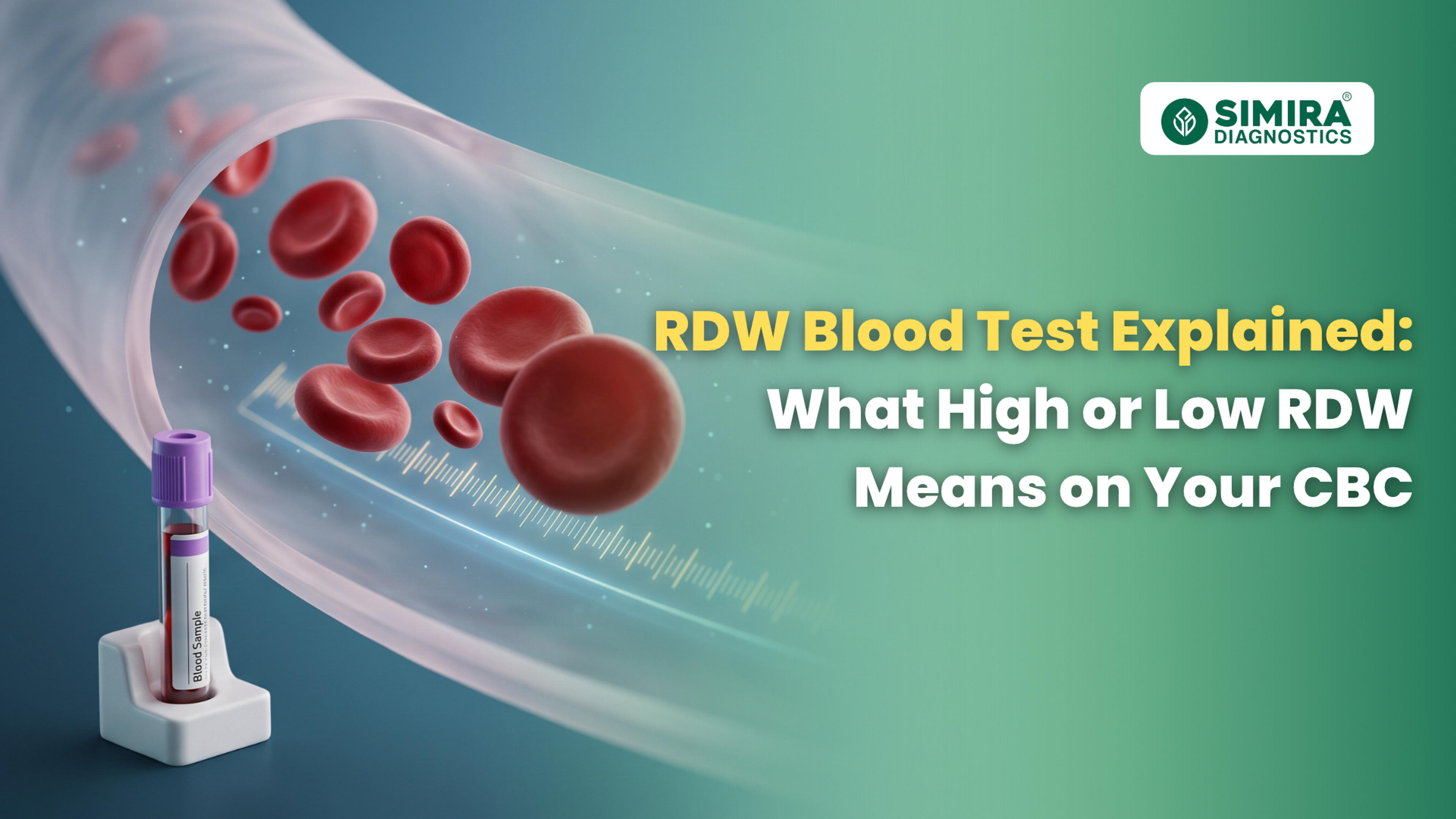
The RDW blood test measures the variation in the size of red blood cells (RBCs). Red blood cells carry oxygen from the lungs to different parts of the body. Normally, these cells have a relatively uniform size. However, certain nutritional deficiencies, anaemia and other medical conditions can cause variations in their size.
An RDW result may be reported as high or low in a CBC report. But what does it indicate? Does a high RDW mean anaemia? Is low RDW a cause for concern?
In this blog, we will explain the RDW blood test, its normal range, clinical significance and what high or low RDW levels may indicate.
What Is an RDW Blood Test?
RDW stands for Red Cell Distribution Width. It is a parameter included in a Complete Blood Count (CBC) that measures the variation in the size or volume of red blood cells.
This variation is medically known as anisocytosis.
When red blood cells are relatively similar in size, the RDW value is generally within the laboratory's reference range. When there is greater variation in their size, the RDW value may increase.
The RDW blood test helps healthcare professionals evaluate certain types of anaemia and understand red blood cell abnormalities. It is usually interpreted alongside other CBC parameters, particularly:
- Haemoglobin (Hb).
- Mean Corpuscular Volume (MCV).
- Mean Corpuscular Haemoglobin (MCH).
- Mean Corpuscular Haemoglobin Concentration (MCHC).
- Red Blood Cell (RBC) count.
Important: RDW alone cannot diagnose anaemia or identify its exact cause. It must be interpreted along with other blood test results and clinical findings.
What Is the Normal RDW Range?
The normal RDW range can vary depending on the laboratory, testing method and type of measurement used.
RDW is commonly reported in two forms:
| RDW Parameter | Typical Reference Range |
| RDW-CV | Approximately 11.5%–14.5% |
| RDW-SD | Approximately 39–46 fL |
These are commonly encountered illustrative ranges, not universal diagnostic cut-offs. Always refer to the reference interval printed on your laboratory report.
Difference Between RDW-CV and RDW-SD
1. RDW-CV (Coefficient of Variation)
RDW-CV measures the variation in red blood cell volume relative to the average red blood cell volume. It is expressed as a percentage (%).
2. RDW-SD (Standard Deviation)
RDW-SD measures the actual spread of red blood cell volumes in femtolitres (fL). Unlike RDW-CV, it is not expressed as a percentage.
Both measurements help assess variations in red blood cell size, but their values and reference ranges are not directly interchangeable.
What Does High RDW Mean?
A high RDW indicates that red blood cells show greater variation in size than expected. This means the bloodstream may contain a mixture of smaller and larger red blood cells.
A high RDW is commonly associated with certain types of anaemia and nutritional deficiencies. However, it does not confirm a specific condition on its own.
Common Causes of High RDW
1. Iron Deficiency Anaemia
Iron is essential for haemoglobin production. When the body does not have enough iron, red blood cells may become smaller than normal. As new and older red blood cells differ in size, RDW may increase.
2. Vitamin B12 Deficiency
Vitamin B12 is necessary for healthy red blood cell production. A deficiency may result in the formation of larger-than-normal red blood cells and increased variation in cell size.
3. Folate Deficiency
Folate supports DNA synthesis and normal red blood cell development. Low folate levels can affect red blood cell formation and may lead to increased RDW.
4. Mixed Nutritional Deficiencies
When iron deficiency occurs alongside vitamin B12 or folate deficiency, red blood cells may vary significantly in size. This can result in an elevated RDW.
5. Certain Chronic Medical Conditions
Some chronic inflammatory conditions, kidney disorders and other illnesses may be associated with changes in red blood cell production and RDW.
6. Recent Blood Loss or Blood Transfusion
Following blood loss or a transfusion, red blood cells of different sizes may circulate together. This can temporarily influence RDW measurements.
What Does Low RDW Mean?
A low RDW indicates that red blood cells are relatively uniform in size, with less variation than the laboratory's reference interval.
Unlike a high RDW, a slightly low RDW is generally not considered clinically significant when other CBC parameters are normal.
A low RDW alone usually does not indicate a specific disease or nutritional deficiency.
Healthcare professionals generally interpret it alongside haemoglobin, MCV, RBC count and other blood parameters.
High RDW vs Low RDW: Key Differences
| Parameter | High RDW | Low RDW |
| Meaning | Greater variation in red blood cell size | Less variation in red blood cell size |
| Common interpretation | May be associated with nutritional deficiencies or anaemia | Usually has limited clinical significance |
| Possible causes | Iron, vitamin B12 or folate deficiency; mixed deficiencies; other conditions | Often normal biological variation |
| Clinical importance | Requires interpretation with other CBC parameters | Usually not concerning in isolation |
How Is RDW Interpreted Along With MCV?
RDW becomes more useful when interpreted alongside MCV (Mean Corpuscular Volume), which measures the average size of red blood cells.
The combination of RDW and MCV can help healthcare professionals understand the possible type of anaemia.
| RDW Result | MCV Result | Possible Interpretation |
| High RDW | Low MCV | May suggest iron deficiency anaemia |
| High RDW | Normal MCV | May occur in early iron deficiency, mixed nutritional deficiencies or recovery after blood loss |
| High RDW | High MCV | May be associated with vitamin B12 or folate deficiency |
| Normal RDW | Low MCV | May be seen in thalassaemia trait or some other causes of microcytosis |
| Normal RDW | Normal MCV | May occur in several conditions, including some forms of anaemia |
Note: These patterns are not diagnostic. Additional tests and clinical evaluation may be required to identify the underlying cause.
When Should You Get an RDW Blood Test?
RDW is generally included as part of a Complete Blood Count (CBC). A healthcare professional may recommend a CBC when evaluating symptoms or monitoring certain medical conditions.
Symptoms that may lead to a CBC evaluation include:
- Persistent tiredness or weakness.
- Dizziness or light-headedness.
- Pale skin.
- Shortness of breath.
- Rapid or irregular heartbeat.
- Unexplained fatigue.
- Suspected nutritional deficiencies.
The RDW result may help the healthcare professional investigate possible red blood cell abnormalities.
How Is the RDW Blood Test Performed?
The RDW blood test is performed using a blood sample collected from a vein, usually in the arm.
The sample is analysed using an automated haematology analyser, which measures different blood cell parameters, including red blood cell size and distribution.
Is Fasting Required for an RDW Blood Test?
No. Fasting is generally not required for an RDW blood test because it is part of the Complete Blood Count (CBC).
However, if other tests are prescribed along with the CBC, fasting may be necessary depending on those tests. Follow the laboratory's instructions.
Other Tests That May Be Recommended Along With RDW
If the RDW result is abnormal, a healthcare professional may recommend additional investigations depending on the CBC findings and suspected cause.
These may include:
- Serum Ferritin: Helps assess the body's iron stores.
- Serum Iron and TIBC: Help evaluate iron availability and iron-binding capacity.
- Vitamin B12 Test: Helps identify vitamin B12 deficiency.
- Folate Test: Helps assess folate levels.
- Peripheral Blood Smear: Examines the size, shape and appearance of blood cells under a microscope.
- Reticulocyte Count: Measures immature red blood cells and helps evaluate bone marrow response.
Not everyone with an abnormal RDW requires all these tests. Further investigations depend on individual clinical findings.
Why Is the RDW Blood Test Important?
The RDW blood test provides useful information about red blood cell size variation and supports the evaluation of certain blood-related conditions.
Its clinical significance includes:
- Assessment of anaemia: Helps identify patterns associated with different types of anaemia.
- Detection of nutritional deficiencies: May provide clues about iron, vitamin B12 or folate deficiencies.
- Evaluation of red blood cell abnormalities: Helps identify variations in RBC size.
- Support for further investigations: Helps healthcare professionals decide whether additional tests are needed.
- Monitoring selected conditions: May be used alongside other blood parameters during clinical follow-up.
Conclusion
The RDW blood test is an important component of a Complete Blood Count (CBC) that measures variations in red blood cell size. A high RDW may provide clues about iron deficiency, vitamin B12 deficiency, folate deficiency and other conditions affecting red blood cell production. A low RDW, on the other hand, is generally not considered significant when other blood parameters are normal.
However, RDW should never be interpreted in isolation. Haemoglobin, MCV, RBC count and other clinical findings are important for understanding the complete picture of blood health. If your RDW result is outside the laboratory's reference range, consult a qualified healthcare professional for appropriate interpretation and further evaluation.
Medical Disclaimer
This article is intended for general educational and awareness purposes only. It is not a substitute for medical diagnosis, treatment or professional medical advice. Health screening recommendations vary according to age, sex, symptoms, medical history, medications, family history and individual risk factors. Please consult a qualified healthcare professional before deciding which tests or screenings are appropriate. Do not start, stop or change medication based solely on information in this article.